
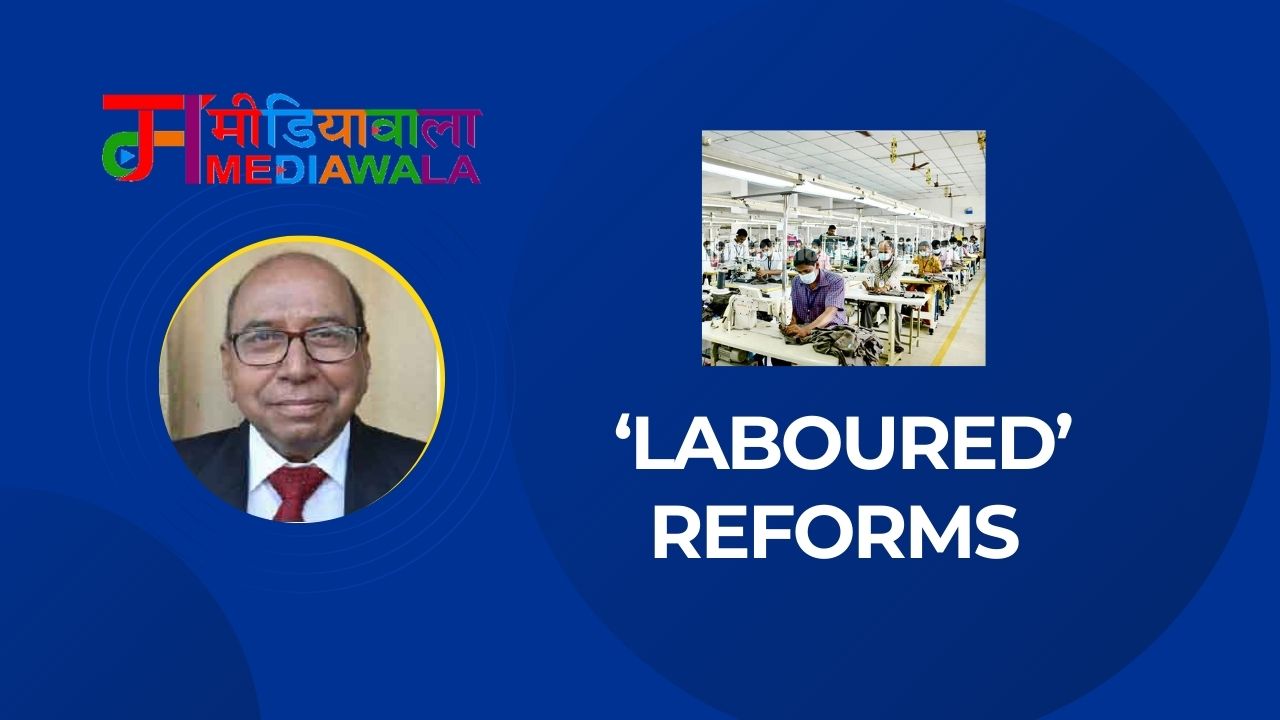
‘Laboured’ Reforms
– N K Tripathi
In an otherwise, gloomy international scenario, an encouraging message is for economy. In the second quarter of the FY 2025–26, the economy grew by 8.2%. Many economists are hopeful that Indian economy is likely to achieve the $4 trillion mark in the current financial year itself.
India is not casually the fastest growing economy, but by continuous reforms since 1991. However, bringing daring reforms in Indian democracy is politically perilous, as we have seen in the case of agricultural reforms. Politicians have fallen in love with the freebies instead of the long-term efforts.
Modi Govt has done some politically calibrated reforms in the system. Introduction of GST, bankruptcy laws, reduction in income tax and decriminalising provisions of the company law are some examples. It has helped the ease of doing business.
There is a crying need to reform the labour market. Labourers in the formal sector are estimated to be only between 13% and 17%, while others are in the informal sectors. Many more are unemployed. Labour unions and political parties are only concerned with the better off labourers in the formal sector. Labour laws only protect them. The huge informal sector is usually unregistered and labourers have no protection. Many businesses in India want to remain small or hire contract labourers to avoid labour laws. This kills the chances of natural labour intensive industries in India. This keeps large number of people unemployed- all to protect a few labourers of the formal sector. Industrial Disputes Act 1947 forbids enterprises with 100 or more from laying off workers under any circumstances. Firms in Bangladesh, Vietnam and China do not face similar policy rigidities. Two top firing engine- economies, US and China have a labour policy of ‘hire and fire’.
Five years ago, Parliament passed the laws on four labour codes to replace 29 Central archaic labour laws. But the government was scared of giving effect to them by notifying. Some states started implementing politically convenient various provisions piecemeal. Only after this, the central government has moved to notify recently these 4 codes, claiming this as a big reform. The three codes are mainly for welfare but not without bureaucratic cobweb. The fourth Code of Industrial Relations has raised the companies’ threshold or freedom to fire employees without government permission from 100 workers to 300; allowed players to use fixed term contracts and women to work in night shifts. These are hardly revolutionary changes.
Any company which transform from informal to a formal company, suddenly it has to contribute PF, pension fund, health insurance, gratuity and leave travel allowances. Many firms of even formal sectors choose to remain small. In India, there are no mega factories for fear of labour laws. The government attempts to look friendly with the entrepreneurs giving them some flexibility, while showing itself Improving the workers’ rights and benefits. No wonder India has millions of unemployed or semi-employed people in rural and urban areas.
However, some ‘laboured’ beginning has been done. Let us hope that at some point in future, political bipartisanship may help usher in real reforms.